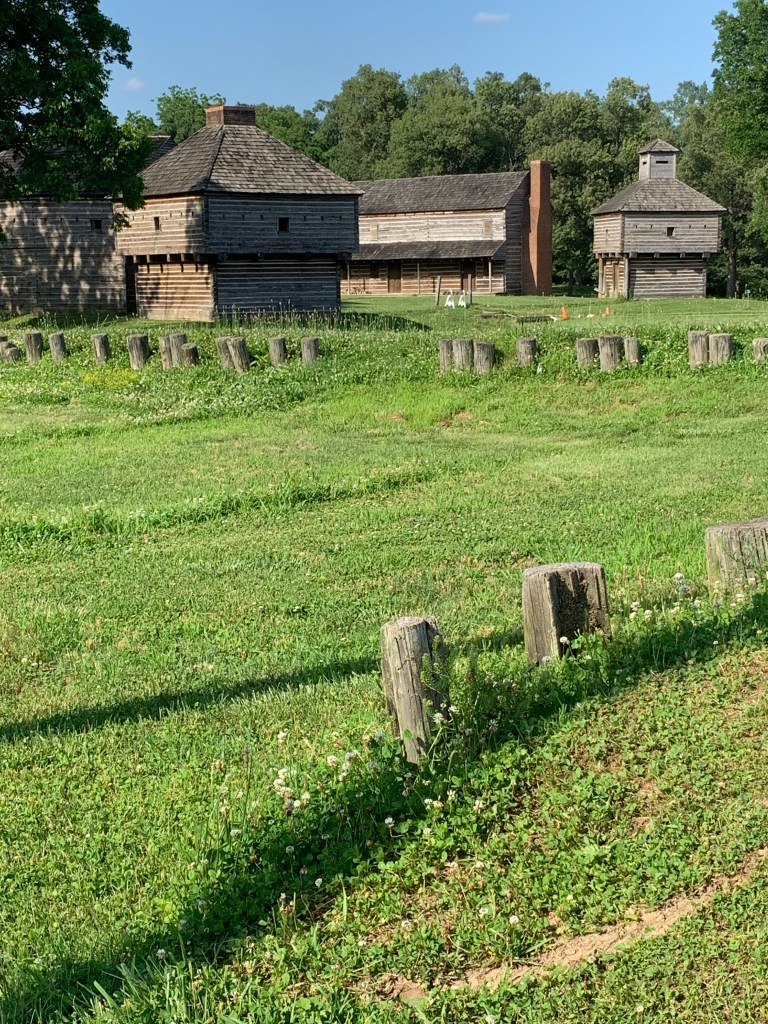
I spent the next day cruising south on much flatter roads, all the way to Fort Massac. It was Sunday, so the bike shop in Paducah was closed until Monday morning. I knew I wanted to hit fort Massac, and if I stayed in Paducah I’d have to back track to get to the bike shop in the morning, so I was excited when I realized the fort had a campground in it. I slept nearly twelve hours the night before and still managed to get there fairly early in the afternoon, so I set up my tent, took a nap and then went out to explore. The visitors center was closed, but they had built a reproduction of the 18th century fort that I got to explore in solitude. I was beside myself with joy. This was the first time I’d encountered a place that looked just as it had when Lewis and Clark had stopped here over 200 years ago. I imagined them walking on the ground where I stood, and tried to imagine what fort life would have been like in 1803.

One thing I’d found incredibly amusing on my way through Indiana and Illinois was how incredibly overshadowed William Clark was by his brother, George Rogers Clark. It’s something I address in my novel, as I feel it severely affects William Clark’s motivation. For those of you who don’t know who George Rogers Clark is (I didn’t before I began my research), he is a Revolutionary War hero, famous for reclaiming Kaskaskia and Vinciennes from the British. As the story goes, the British had the two French towns occupied, and while they expected the Americans would try to take them, they assumed they would wait until after the winter. The waters of the rivers there flooded considerably and it was considered fool hearty to attempt to cross them. But George Rogers Clark and his men from Kentucky were made from sturdy stuff. They were frontiersmen! So they waded through freezing waist deep waters for days. When they got there, they hid their numbers and completely overwhelmed the British before claiming the towns for their own. This made Clark a legend in Indiana and Illinois. Trouble was, he spent his own money on the gunpowder his men used in this endeavor, and didn’t keep the receipts, so he went into incredible debt because the country refused to reimburse him. So, in debt he turned to drinking, and William Clark had to leave the army to help settle up his brother’s financial affairs back in Clarksville, IN. By the time Lewis arrived with a keelboat to grab Clark and head west, George Rogers Clark was in a financial mess, had turned to drinking and been discharged from the army. Yet, in Indiana and Illinois he is still a 20-something war hero, and near every site on the Ohio River that William Clark would have visited, he is a footnote beside a giant statue of his older brother, George Rogers.
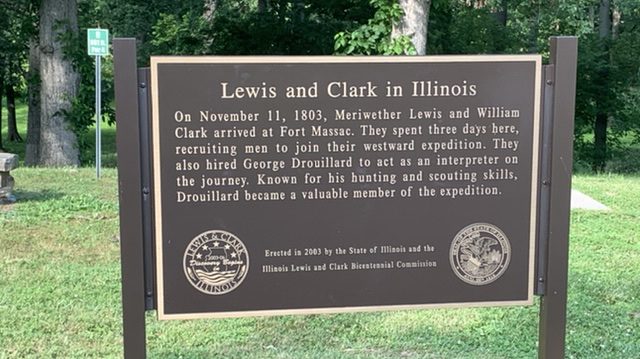
I was awoken that night at 1:30 in the morning by the sound of two animals fighting. I carefully peeked my head out of the tent and saw a raccoon, sitting on the picnic bench at my campsite with his paws on my panniers. I chased him away repeatedly, but by that point he’d managed to steal two protein bars from a back on my bike rack and was fighting another raccoon over rights to my food. Turns out he hadn’t just gotten at the protein bars, he’d figured out the zippers on my panniers and stuck his little paws into my bear bag. I hadn’t been particularly careful about tying up the bag because I wasn’t in bear country yet. I wrongly assumed the zipper would be enough to deter anything else.

I had had enough. I felt like garbage and I wanted to sleep, but these darn animals were preventing that. So, I threw away the peanut butter they’d gotten into in my pack, unlocked my bike, and rolled the darn thing next to the shower building underneath bright street lamps. I tied the food bag up, zipped the zippers all the way to one side and locked my bike up again. Let them try, I was going back to sleep, and at least they wouldn’t be fighting less than ten feet from my sleeping head. It seemed in the morning that had been enough to get them to give up. I visited the visitor center museum as soon as it opened and biked into Paducah to have someone look at my bike. Turned out they replaced the cables in Iowa City without telling me, and that was more than half the problem. The technician said my chain looked fine, as did my cassette. He tightened my cables and I took off to see the Lewis and Clark statue outside of the quilt museum. I went for a quick loop along the flood wall to look at the murals being painted there. Turned out the same company that painted the murals in Point Pleasant were now painting murals here. I stopped at a coffee shop and continued on to the motel I’d planned to stay at.
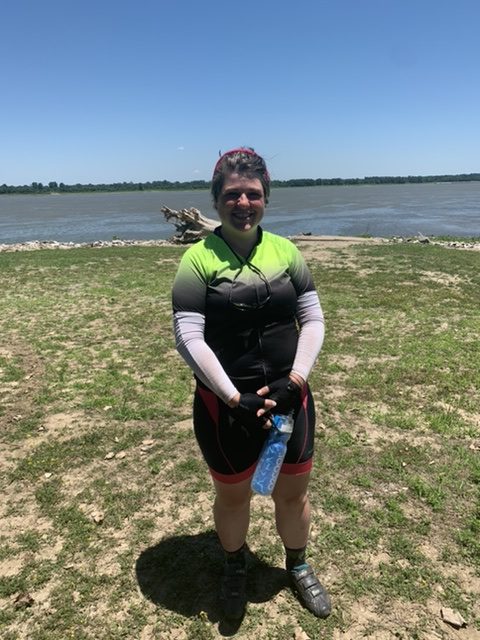
By 1pm the next day I made it to the Confluence of the Ohio and the Mississippi Rivers. I had officially biked the entire length of the Ohio River. I talked with a biker (motorcycle) for about an hour about my adventure. He told me he was going on a ride to retrace his family’s history. He was going south on the Mississippi while I was headed north. Shortly after I crossed the Mississippi River into Missouri for the first time and stayed at a hotel in Cape Girardeau. I stopped for coffee on my way out of town.
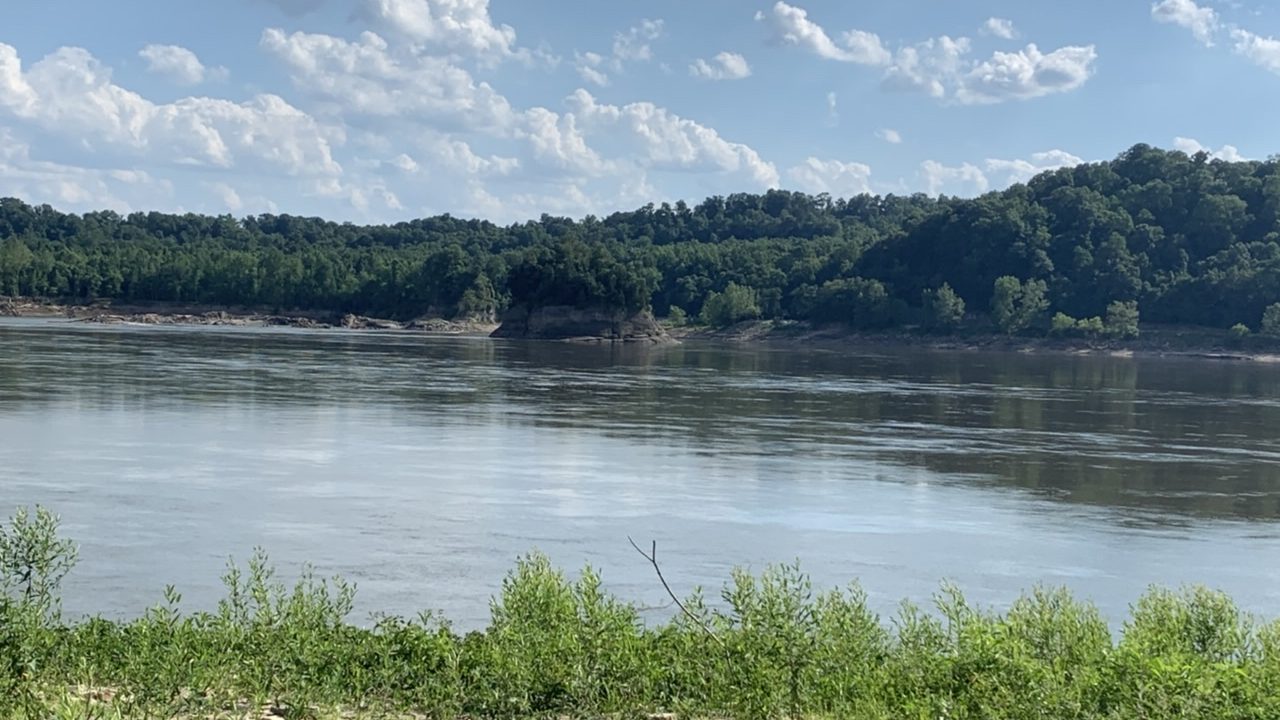
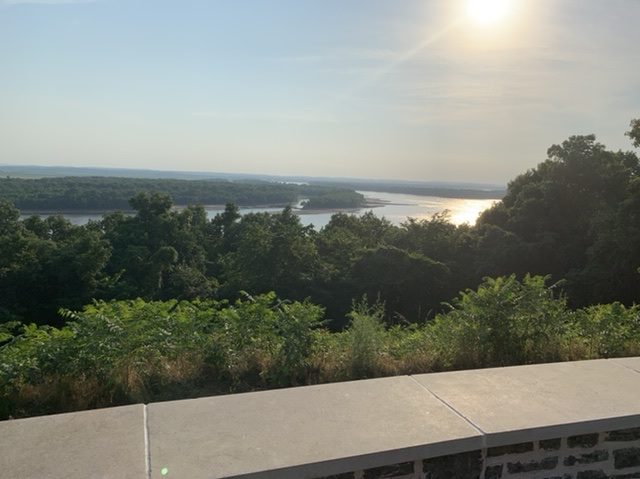
I spent the night at Devil’s Backbone Campground. The owner told me it was their first week opened since 2019 when the Mississippi flooded and took out their entire campground. It was right on the river with a beautiful view of Tower Rock and a historical marker that said that Lewis and Clark had camped across the river near the rock.
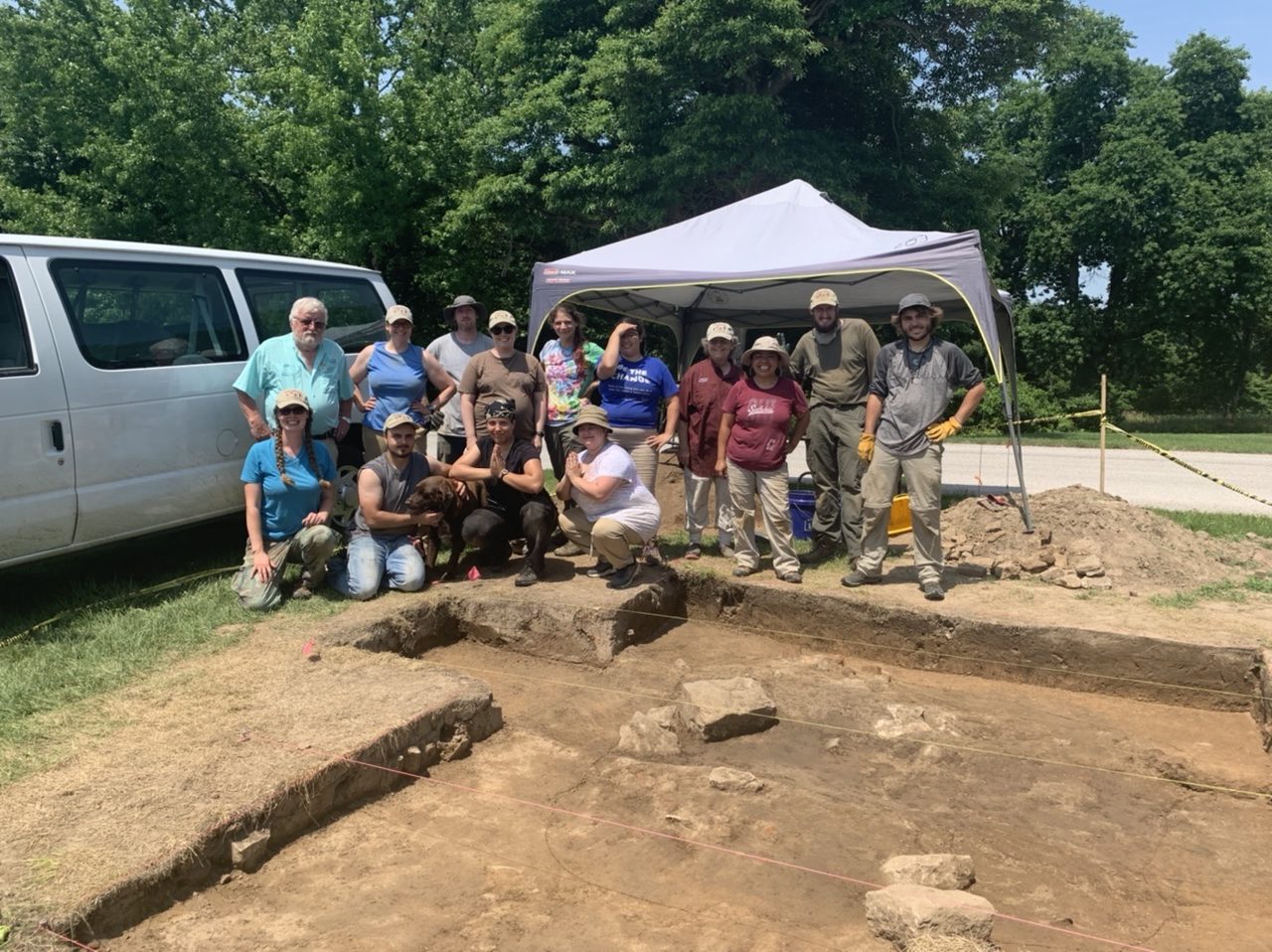
I got started early again. I was finally starting to feel healthy after two weeks of phlegm. It was an incredibly hot day and only got hotter, but I made excellent time, especially considering how brutal the hills were near Chester, IL. I biked to my intended stop, Fort Kaskaskia, by about 1pm. It was atop a large hill with a number of switchbacks, and by the time I got to the top I was panting for breath, so I sat on the ground and chugged some water, dried some of the vast quantities of sweat pouring down my forehead, and waited to catch my breath. I sat down in front of a historical marker, and what looked like the same mounds I saw at Fort Massac that formed the outline of the original fort. As I waited a van pulled up and a number of people got up and headed to a tent on the far side of the grass. It looked like they were excavating and I was fascinated. I followed them and asked politely if i could watch them work. They said yes, and shortly after, their professor, Dr. Mark J. Wagner showed up. I’m guessing I caught them just after their lunch break. It was perfect timing. I asked him a few questions about the fort, particularly about fort life in 1803. He told me the site we were at was originally a French fort but there was no evidence that it had ever been put to use. There was another site, just down the road, that they had discovered fairly recently, it seemed like a cellar and they’d found a number of U.S. Army buttons, circa 1803. They’d been excavating this site each summer for four years. No one had known where the American fort was, but they’d made this groundbreaking discovery. He let me follow him to the other site and I observed them for at least an hour. He gave me anecdotes about the history of the site and even sent me off with a copy of We Proceed On: Lewis and Clark Trail Heritage Foundation magazine, which featured an article he wrote on the excavation. This was one of the most magical moments I’d experienced on the trail.
I got some advice about fires in Montana and the Dakotas, contact information from the bioarchaeologist their who’s father is a part of a Northwest bicycling group, if I needed any advice on navigating the Rockies. The next day was supposed to hit at least 100 degrees. They had an inspection in the morning and were packing up early to avoid the heat and crossing the river to get ice cream. I was told they’d be back there at 9am if I wanted to stop by before I left. Sadly, because of the heat, I decided to leave before 7am to try to get to Festus, MO (my end point) before the hottest part of the day.
I handled the heat exceptionally well. I made sure to drink water constantly, and managed to keep my water bottles full, so as I got closer to Festus and the heat neared 100 degrees, I felt comfortable enough with my water situation to pour a bottle over my head to cool off. Any time I found shade I took a brief break, and by the time the heat peaked I was only a mile or two away from my hotel. I was disappointed when I arrived to find out the pool I’d been excited to dive into all day was still closed, presumably because of Covid, but I took a cold shower and relaxed in my room, and I did still manage to feel refreshed. I got up pretty early and headed for Saint Louis the next morning. I needed to get to the Post Office before 12:30 so I could pick up a newly purchased GPS tracker I’d purchased to help insure my parents sanity. Unlike my first tracker, this one didn’t require cell service to find my coordinates and it allows me to call for help in emergencies, as well as to contact my parents if I’m stranded, in addition to updating them on my location regularly. I got there intime and took the next day off in Saint Louis.
 The Stars On the Horizon
Your trip sounds great. Lovin’ the pics. Stay safe.
LikeLike
Hi, Meghan, I enjoyed the Zoom presentation you made this week about this fantastic trip. It was very interesting with lots of good images. Congratulations on your accomplishment. I imagine that it was very satisfying.
My husband and I are heading out today for a simple bike-overnight trip, ending at Fort Massac, so I came here to look at that part of your blog. Before I married, my surname was Clark, so I hope you’ll forgive my enthusiasm for this aspect of your journey. I am a collateral descendant of William, George and their siblings (their uncle was my direct ancestor), but I did not know this until I was about 30 years old even though my grandpa always said, “we’re kin to those Clarks.” I didn’t pay any attention when I should have.
George’s story in particular is interesting to me because, as you point out, he was a tragic hero. He was also responsible for securing the territory which became Illinois, my home state, so I always thought that Illinois could do better to recognize that. Of course, now, with some perspective, I also know that George’s (and others’) exploits robbed the native population of their homeland, so I am conflicted about his “hero” nature.
But I wanted to mention one tiny thing in your account that I would dispute. Please don’t take it as criticism, because I enjoy your blog very much. But George most certainly did submit receipts. It’s just that the political environment after he had won the Northwest Territory was much different than the one during which he pledged his personal assets to the benefit of the state. The result was, of course, that he was financially ruined. He divested himself of most of his land holdings, deeding them to relatives and friends. This was one reason that the family of my own ancestor, Benjamin Clark, ended up settling around Edmonton, KY – Cousin George gave them some land.
George tried to remain loyal to Virginia, but he was frustrated at being repeatedly rebuffed. The whole sordid tale is retold in an article by Temple Bodley, in the Journal of the Historical Society (of Illinois), published in 1936. What I found astounding is that the vouchers were actually found – in 1913 (!) – in dusty storage in Richmond. From the article:
“Nor was that the first account he rendered the state, for he had presented one in 1780, supported by thousands of his original vouchers. They were receipted for by the auditor, but lost by him when Benedict Arnold invaded Virginia in 1781, and burned the public buildings at Richmond. But the accounts and vouchers were never destroyed. Instead they remained amongst the auditors papers for 133 years until finally discovered in 1913 in a dusty basement of the auditor’s office.”
Bodley, T. “George Rogers Clark’s Relief Claims,” Journal of the State Historical Society, Vol. 29, No 2 (July 1936), pp. 103-120.
Cheers!
Molly
P.S. My parents once visited Fort Clatsop, and, like you, they arrived late in the day. The visitor’s center was about to close but they wanted to see the fort, so the ranger told them to go immediately to the fort and then come back and pay the $5 admission charge. Of course, when they got back to the visitor’s center, it was closed and the ranger was gone. Mother thought they should find some way to pay the $5 per person, but Dad (joking) replied, “After what they did to George?!”
LikeLike