
We started at the Lolo Pass Visitor Center and went on a brief hike to try to find the site Lewis and Clark had camped at when they passed through these mountains. My mom didn’t want to go on a particularly long hike and the paths were kind of convoluted, so we couldn’t find the location. In back of the center though, there was a monument dedicated to Stephen Ambrose, who wrote Undaunted Courage about the Lewis and Clark Expedition. He evidently helped save parts of this forest from logging companies and destruction. We made friends with two Oregon locals and their mini schnauzer before we hit the road.

It was so cold on this mountain, so different from the others I experienced, that as I rolled quickly downhill I started shivering, teeth chattering. I pulled over and waited to wave down my mom. I needed more layers. For the first time I kept the layers on most of the day. The Montana side of the mountains to the Idaho side I felt like I was in a completely different country. The golden grass, pine trees and corroded rock gave way to a varied forest of dark, thick, green woods, every surface covered by a moss three inches deep. I had my mom meet me at the turn off to go down the windy gravel road toward the Nez Perce Trail at the top of the mountain ridge, the exact trail Lewis and Clark used to get across the mountains to the Pacific and back home. This route was nearly 200 miles and most of it required four-wheel drive. My mom was driving a Toyota Corolla. We took the Lolo Pass ranger’s advice. She directed us to roads our car probably wouldn’t have trouble on. Because it didn’t make sense for me to bike down roads my support vehicle couldn’t get to for a week straight, I convinced myself to let me drive these safe-ish ranger approved roads so I could get a feel for the location before I continued down the mountain. I popped my bike on the back and got in the driver’s seat. My mom’s afraid of heights, and I am much better with driving treacherous roads than she is. At first it was just a narrow gravel road through the same mossy woods we’d seen all day, but as we crept upwards the slope dropped suddenly alongside us. We climbed upwards and that drop grew deeper and deeper until we were winding up the side of a mountain, straddling the delicate balance between staying away from the edge and avoiding rocks and potholes that might break us down. How would a tow truck even get up here to rescue us if we broke down.
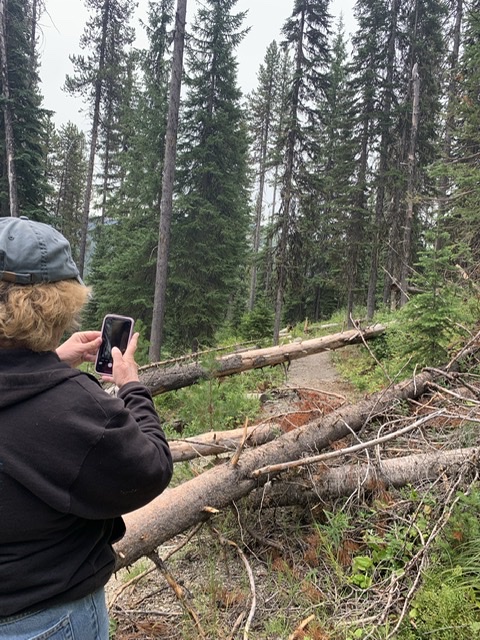
It was at least an hour up these windy, brush and bush covered mountain sides. The view was spectacular, it looked like it could be just as uncharted as it was when Lewis and Clark came through more than two hundred years ago. It looked completely uninhabited, like nature reigned supreme. I would have biked it. I mean to do it in the future. I want to do the whole trail through the mountains when the road hopefully isn’t closed to traffic. We got to the intersection we’d been advised to turn down and head back to the main road. It was a five-way intersection. Two forks led down the Lolo Trail, that Nez Perce trading route that had existed for centuries, one lead back the way we came. We knew that path, and one lead back down, but it was new. We debated for a moment and went down the new road. I wanted a new adventure and how could it be much worse than the one we’d just come up?
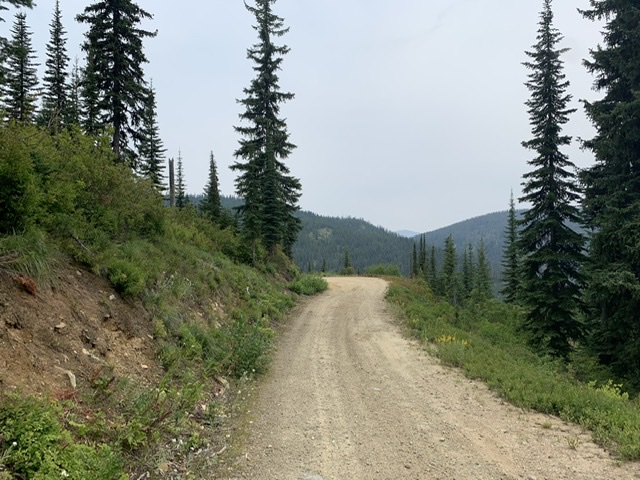
The roads were similar. They were windy and dropped off one side just as they had on the last road, but this one was the type of service road that had two tire tracks from where trucks had traveled up it with a chassis clearance high enough to leave a strip of vegetation still growing down the center of the road. Our car was so low to the ground that the whole drive we could hear grass and wildflowers scraping the bottom of the car. We avoided rocks just as before, but somehow on this side of the mountain it had rained and occasionally we reached muddy stretches and deep puddles in the road. I was proud of how well I handled the car. When I saw these hazards I stopped where the road looked stable and dry enough, examined and planned my route, and plowed through the mud like a champ. I knew I was more likely to get stuck if I tried to navigate it slowly. The logic served me well. We didn’t for a moment think we might be stuck, and got down the mountainside deftly, back to the main road in time for lunch.
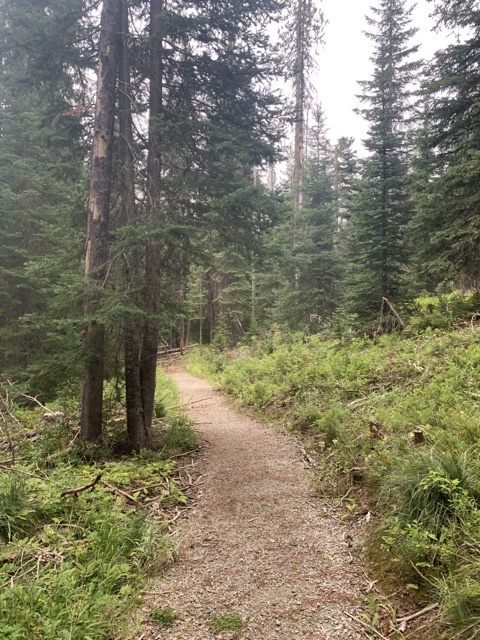
There was a campground and a town nearby, we filled up the gas tank and went to a lodge for lunch. It was raining on and off here. When we got back to the road so I could start biking again I realized my rear light had gone missing. I had left it on the bike, attached to the bike rack while we had jostled up that bumpy road. There was no use trying to look for it. I had a back-up, or thought I did. I kept a light clipped to the back of my helmet for days where I felt extra invisible. It had come off my helmet though, and after emptying the car twice searching for it to no avail, I gave up. I grabbed my camping headlamp, which has a blinking red light option, and macgyvered it onto the back of my cycling jersey.

I often talk about the pay off of biking up hills and then coasting down the other side. I complained about the Lemhi Pass and missing out on that joy. I relished the Lost Trail Pass because I coasted downhill at about 30 mph, traveling about 50 miles with little effort. This mountain was different. It was the most difficult pass Lewis and Clark crossed. It was also the most difficult one I’d crossed. The incline from the day before had come suddenly and it was incredibly steep. It may have been the shortest in elevation, but the incline was the shortest in miles too, and the other side, I coasted for maybe 10 miles, and then for days I biked uphill as much as I biked downhill. I met up with the Lochsa River, and every time it bended I told myself I’d reached the other side of the mountains. Every time the mountains continued.
That evening, between rain showers I arrived at the Gateway of the Wilderness. I told myself this meant we were coming out the other side, that we were almost out of the wilderness, out of the mountains, but I out yet.
 The Stars On the Horizon