
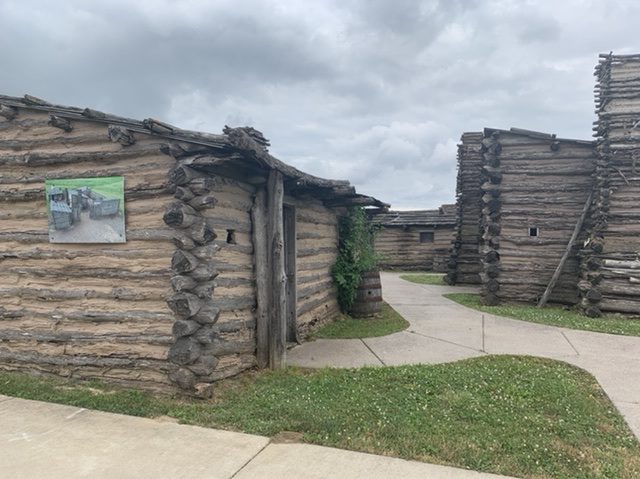
I followed a bike path north to Hartford along the top of a levee for miles and miles. It was still afternoon when I got to the Lewis and Clark State Historic Site. The museum was closed, but there was a reproduction of the fort the men of the Corps of Discovery built for the winter of 1803-4. I wandered around the buildings, took a few pictures and uncomfortably noticed a no trespassing sign on one of the buildings. My understanding was that it was to keep people from going inside the buildings, but I didn’t wander beyond the perimeter just in case. From what I can tell they have historical interpreters there and the insides are just as reproduced as the building itself. I noticed as I walked around the outside of the visitors center that there was some sort of a children’s class going on inside. By the time I was ready to leave, a summer camp was letting out. How cool is a national park service summer camp? Exploration and history all in one.
I spoke to the counselor, told him I was biking the trail and he let me quickly explore the exhibits inside. I was thrilled, since this was the first spot I had seen a reproduction of the keelboat Lewis and Clark used. I’ve mentioned previously that so many of the places I stopped, Lewis and Clark were a footnote or an add-on, not the primary focus, but this was the first location they were front and center. Sadly the Lewis and Clark Confluence Tower was also closed on Monday and Tuesday, so there was no vantage point for me to see the Confluence of the Missouri. I continued on bike paths north until I reached Père Marquette State Park and camped for the night. The tent camping was tucked far back into the woods, and in the middle of the night I woke to hear the howling of a pack of coyotes not too far off from my tent. I was getting used to the sounds of animals in the night.
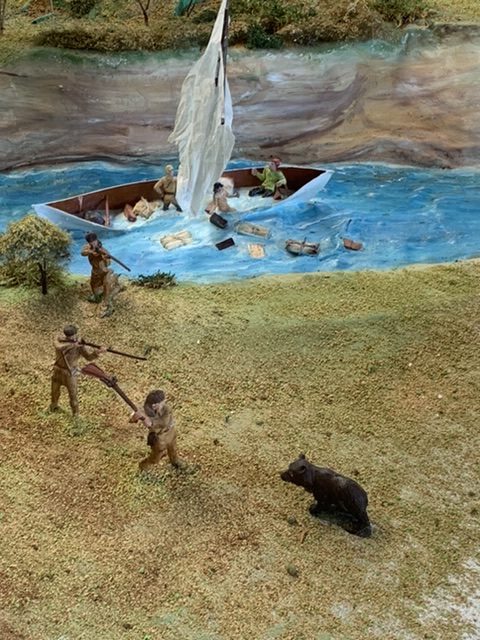
The next day I took a ferry across the Mississippi, rode through farm and conservation land back to to Missouri. Yet another ferry brought me to Saint Charles, one of the last vestiges of Western Civilization that Lewis and Clark saw before two years out in the wilderness. I spent the morning into the afternoon there, planning the next few days of riding. I visited the Lewis and Clark Boathouse and Museum which was filled with dioramas of specific events contained in the journals with their corresponding quotations. I was gleeful seeing so many familiar moments. The exhibit ended with the National Geographic documentary on the expedition. I knew they had made a documentary but I hadn’t seen it yet. It was primarily a reenactment and was done so well that I teared up. It was all so familiar and close to my heart. I’d written about some of these moments, imagined them, and now they were being played out in front of me. If I wasn’t biking I would have bought the DVD in the gift shop, but as was often the case, I couldn’t justify adding the weight to my gear. I did take pictures of the books I wanted to purchase in the future, I bought two more volumes of We Proceed On, the magazine Dr. Wagner from the archaeological excavation had given me, and a thin book of poetry called Buffalo Dance by Frank X. Walker, written from the perspective of York, William Clark’s slave. That was worth the weight. I’ve written from York’s perspective in my book, but every word felt false. I read Roots, trying to find the most authentic voice I could, but I still wasn’t there. Frank X. Walker is a founding member of the Affrilachian Poets, and I was excited to get his perspective on York’s motivations.
This was my first day on the Katy Trail. I was blissfull. The Katy trail is the longest continuous bike path in the country. It was a railroad which means it was hundreds of miles of flat. I rolled through forests, bottomlands, farmlands. I followed the banks of the Missouri, biked beneath bluffs more than a hundred feet high. Every ten or so miles there was a historical marker that talked about what happened to Lewis and Clark at this location in 1804. I was the happiest I’d been on the trail so far. I felt so in touch with the story.

The first night I stayed in Marthasville at a campground on a high school baseball field. A father and son were camped there as well. They were spending a day or two biking the Katy Trail. I was impressed that this kid, maybe twelve years old was excited to ride about 25 miles in a day with his dad. You could barely get me to bike out of my neighborhood at that age, since I lived at the bottom of two hills. I did a few days in a row of 65-75 miles. The second night I had a disconcerting interaction with a very drunk biker dude at a bar. I’d stopped primarily for a cold drink and some air conditioning, but this man, through multiple burps a sentence, asked me four times where I was going to sleep that night. I was thoroughly creeped out. I told him I didn’t know, which was a lie, but he guessed every campground it was reasonable for me to get to that night. I felt unsafe, so, I stayed at a hotel in Jefferson City instead.
The next day I had lunch at a bike shop cafe called Meriwether, tickled that my boy Lewis’s namesake was used for a cafe on this trail. It had been raining on and off all morning. The trail was closed ahead because a bridge was out. I asked the manager of the bike shop what the detour was. He told me if it hadn’t rained so much I would have been able to walk my bike through the creek and not take a detour, however because of the rain it was unlikely passable. That meant hills for the first time in a few days and a few miles of detour. I managed it, and got to the end of the trail—or at least, where I diverged from it. As soon as I was off the trail for good, it was hills again, hills and rain on and off. I pushed myself though and got to Arrow Rock within a few hours of sunset. I was so disappointed when I found out booth restaurants in town were closed—one had a fire and was under renovation. The other had changed locations. I was mostly disappointed because I had to bike some very steep hills to find this out. I returned to Arrow Rock State Historic Site, the park where my campground was. The silver lining, the shaded, winding road up had a little creek running through it and a mist hung in the air. Just as I started back, on the phone with my dad in the only spot I could find service, the fireflies came out, and when I passed this little creek the earth was sparkling from the light of a hundred of them. It felt like I’d stumbled through a portal into a fairy land.
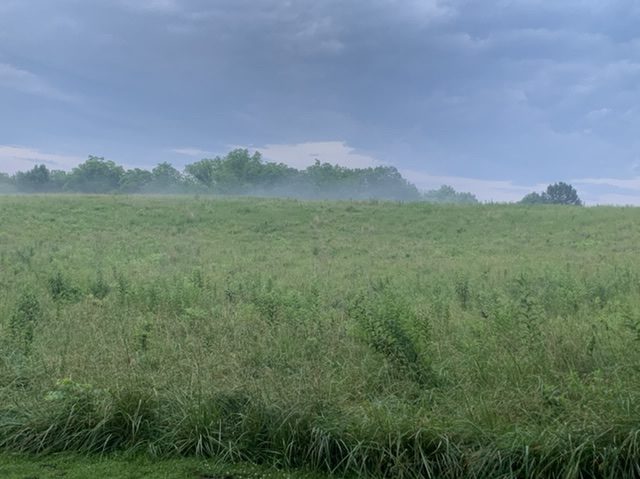
I went to bed just before dark, and was awoken just before midnight by the campground host. There was a tornado warning. I rushed to disassemble my camp, grabbed my sleeping pad and sleeping bag and left everything else behind. He drove me to the visitor center, as I was the only one at the campground without a car. The tornado warning ended, but a severe thunderstorm warning continued. The RV owners went back to the campground, but the campground host said my site was a puddle. I wound up sleeping in the auditorium of the visitor’s center. I woke up at about 6:00 am, the state park employee who stayed there for me went home and a new woman came in for her shift. She said the flooding was so bad the water was up to the lip of the bridge on the way out of town. She wound up arranging for someone to give me a ride to a hotel in Marshall, MO so I would have someplace I could actually stay. As we drove there, I could see that the area was flooded up the entire trunks of trees. I was at my hotel and safe by 9:30 am and spent the day inside, wondering when the flood warnings would end.

 The Stars On the Horizon
One thought on “Rail Trails and River Floods”